New product design, Individual Contributor @ WhiteHat
End-to-end system mapping before a single screen is drawn — APIs, org dependencies, and user journeys treated as one model.
6-milestone delivery plans. Decoupled backend dependencies. 2 months saved at AWS. Designers shipping MUI directly at Venafi.
Trust design, agentic workflow patterns, and transparency at scale — for AI products that earn confidence before they ask for it.
Customer panels replacing roadmap opinions. 12K tickets synthesized into priorities. VP-level alignment without losing the user.
30K → 275K console visitors. 58K dev hours saved on a single pivot. 0 → 300 SaaS customers. 66% friction reduction across 18 workflows. The work shows up in numbers.
Unique console visitors at AWS ECS. Was 30K at project start.
Dev hours saved by decoupling one roadmap dependency.
Enterprise customers on Venafi SaaS — launched from zero.
Console friction reduced across 18 workflows, 110 parity items.
“Ruchita ran viewing parties so our VPs could watch real users struggle. That one session did more for roadmap alignment than six months of decks.”
“She synthesized 12K customer tickets into a prioritized roadmap the entire leadership team aligned on. In one session. That’s not a designer skill — that’s executive leadership.”
Every engagement starts with a system audit — not a wireframe. I map what exists, where it breaks, and what business outcome the design must move. At AWS I produced end-to-end journey maps for 18 workflows and 110 parity items before a single new screen was proposed. The framing is the work.
I run customer panels, synthesize support tickets at scale, and host user testing viewing parties with leadership — so roadmap decisions are grounded in real behaviour, not internal assumptions. At AWS I synthesized ~12K tickets and distilled 25 customer interviews to drive 7 UX-led asks into OP1. Data doesn’t just inform the design. It wins the room.
I scope releases in milestones that ship real value and let the org learn in production. At AWS I defined 6 delivery milestones saving ~2 months of schedule under 90% team attrition. At Venafi I structured a Figma→MUI pipeline so designers shipped production components directly. Shipping frugally is not a constraint. It’s a strategy.
The most leveraged design work happens at the API layer — not the UI layer. At AWS I visualized 10+ API touchpoints to influence 2 CloudFormation templates, enabling single-click workflows engineering had previously said were impossible. At Docker I brought FE and BE teams into hi-fi reviews early to model cost tradeoffs before commitments were made.
Misalignment kills products before bad design does. I use journey maps, vision artifacts, and workshop facilitation to create a single shared model across PM, engineering, and leadership. At Docker I reduced 10 competing PRDs to 5 prioritised initiatives in a single quarter through structured empathy mapping. Alignment is a design deliverable.
Creating design-driven, innovation culture
New Product Development, UX Vision, and Redesign efforts
As a growing company, WhiteHat wanted to (a) increase the speed of innovation and (b) emerge as a thought leader in application security domain.
WhiteHat Security was under an aggressive timeline to improve their year on year (YoY) revenue numbers and the account renewal numbers. For this, they needed to: (a) improve customer acquisition processes (b) create a cohesive platform solution rather than have bloated, and silo-ed product offerings.
Fostering design driven culture at WhiteHat Security, Inc.
The design culture at WhiteHat was tactical before this effort and was primarily driven by product management. Thus, whenever a roadmap was formulated, design and engineering team ran with it. This approach created multitude of problems - (a) lack of context while designing led to poorly designed features and (b) lack of complete understanding about our key user personas led to solving incorrect problems.
After joining WhiteHat Security, I came up with a 30-60-90 day plan to address the usability issues with the product. For the first 30 days, I actively interviewed key stakeholders to identify major UX pain points. Additionally, I did heuristics evaluation to find low hanging fruits. I also facilitated affinity mapping exercises to understand top usability issues.
Heuristics evaluation
Affinity mapping
I also did an initial CSS audit to understand current UI to understand the visual design discrepancies. Additionally, there were no central design systems that the developers and designers could use to create a consistent user experience. Based on these data, we collaborated on the overall UX strategy for the product and phased it in the following manner:
Phase 1: Supporting existing efforts
Phase 2: Validating 2017 product roadmap
Phase 3: New product launch
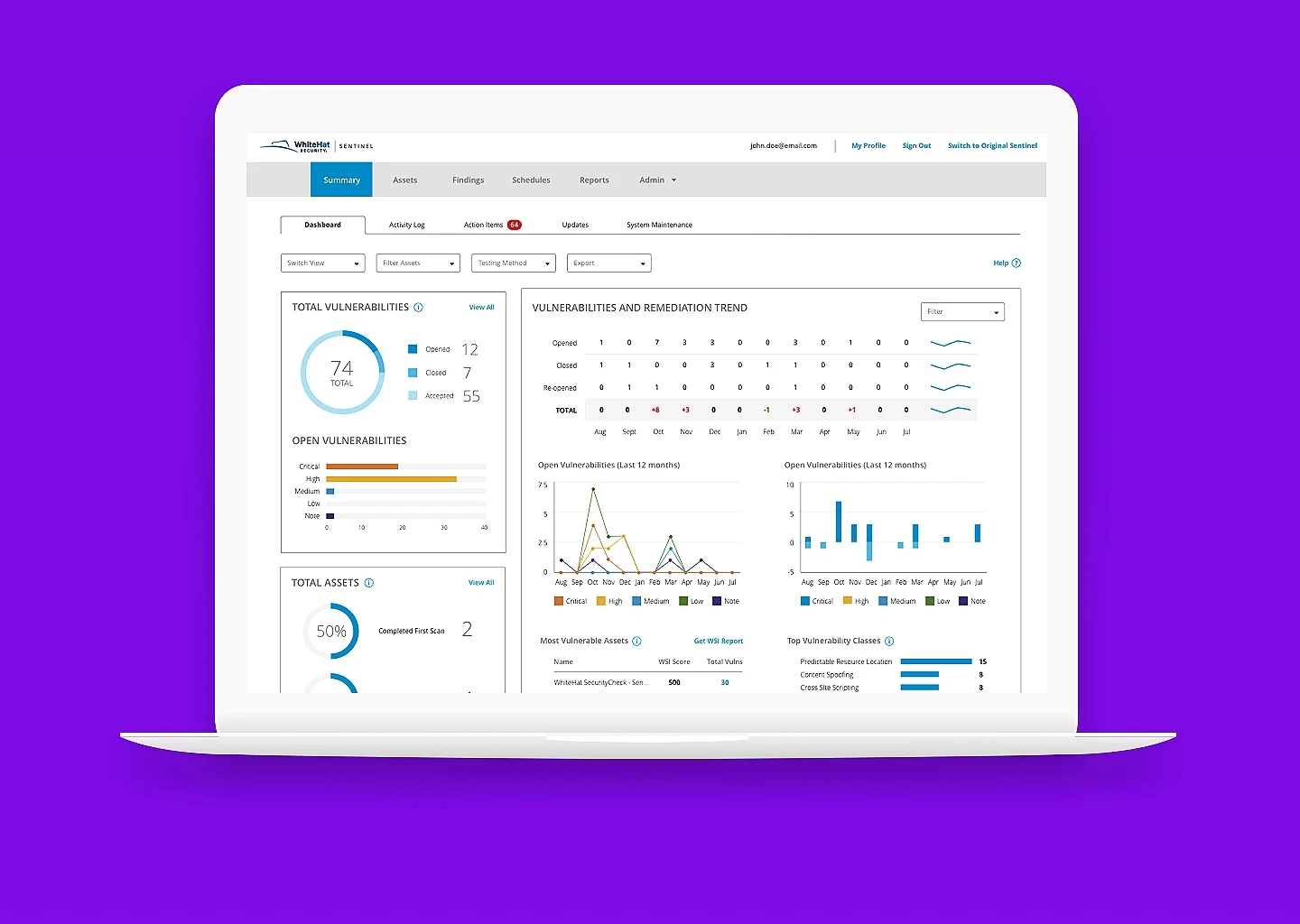
To support existing efforts across 3 different product lines, I worked with the UI team to choose UI framework, create universal design system based on atomic design. These UX patterns were shared via Invision. These UX patterns reduced development and communication time by 15% and helped in creating a consistent user experience.
With our consistent collaborative efforts, we were able to earn a seat at the table where design had tremendous impact on the product strategy and roadmap execution. We started practice of lean UX research to continuously evaluate our key roadmap items with our user base.
The design team started out by interviewing internal stakeholders which included everyone from engineering, product, customer support, and WhiteHat’s Threat Research Team. This guerrilla UX research helped us in creating provisional personas. We posted these personas as graffiti posters across different teams and invited them to scribble on these posters to provide more granular and rapid feedback. We then identified key personas for our roadmap. By working collaboratively, with the stakeholders, we distilled attributes and use-cases for these key personas. A big part of our exercise was deploying guerilla research during various security conferences. At these conferences, we walked up to people visiting our booth and understood their pain points in managing application security program. This helped us in creating a swim lane persona and storyboards where multiple actors work collaboratively.
Using SAP design team’s open-source toolkit – Scenes, for storyboarding, we could rapidly create storyboards for each of the top themes we wanted to validate with our users. We deployed a new product development approach by iteratively working on storyboards and ethnographic UX research during this time to ensure that we are running an agile UX research process.
Graffiti - Personas
Storyboards
Ethnographic UX research
These storyboards helped us in (a) creating cohesive workflows and (b) creating hypotheses that we wanted to validate with the users. We started working through qualitative research using directed interviews with our customers and ethnographic UX research to better immerse ourselves into their context. This has helped us in identifying key focus areas for our roadmap. We could identify patterns from these interviews and align entire organization towards key customer needs.
We could direct significant engineering efforts towards the problems that directly impacted our customers and helping achieve the key metrics of user delight.
Based on the UX research work, we were able to align the company to launch several new products one of which is geared towards DevSecOps persona:
Note: I cannot discuss specifics of this product on the portfolio site due to NDA.
🎖 Personas and storyboards together have helped us craft cohesive workflows and identify gaps in our problem hypotheses.
🎖As a bonus of aligning company with the agile UX research, our engineering team now works with a design mindset and increased empathy towards our users (they have started thinking about use cases that impact our personas).
🎖Based on the customer data, improved product usability has positively impacted application security processes for our end-users. We were able to infuse consumer-grade UI for the product.
🎖Based on the usability changes, we were able to capture the market cap on of our other product line and increase YoY revenue by 30%.
🙏🏻 As a solo designer, I learned how not to get overwhelmed when the onus is put on design to lead design-driven roadmaps.
🙏🏻 As an introvert, I learned how to effectively communicate with the executive team.